
Personal care
What this looks like in practice
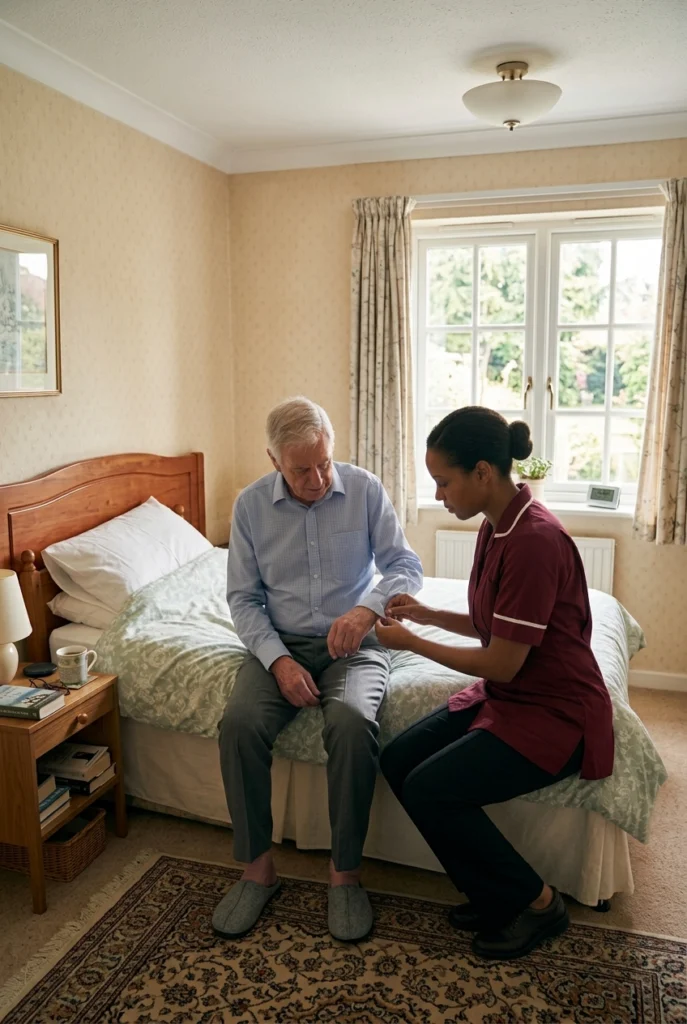
Personal care is the most intimate work we do, and the part we recruit and train hardest for. A visit might be thirty minutes to help someone get up, washed and dressed safely, or an hour in the evening to prepare a meal, prompt medication and settle someone for the night. What does not change is that it happens on your terms: your routine, your bathroom, your preferences about who supports you and how.
Written into your care plan
Every element is agreed before we start and recorded in a care plan kept in your home. If your needs change (after a fall, a hospital stay, or simply over time), we review it with you rather than quietly adjusting what we do.
A typical week
Most personal care packages settle into a rhythm quickly: the same carers, at broadly the same times, doing the same well-understood routine. A common pattern is a morning visit to help with washing, dressing and breakfast, and an evening visit for medication, a light meal and settling for the night, but the honest answer is that it is built around you at assessment, not fitted to a template. Some people need one visit a day; others need four.
How we train for this
Personal care carers complete the Care Certificate, moving and handling training (including hoist use where a package needs it), and medication administration training before working unsupervised. Because this is the most intimate support we provide, we also match on personality and preference wherever we can, including, where it matters to you, the gender of the carer supporting with washing and dressing.
When this might not be the right fit
If needs are primarily clinical (wound care, injections, complex medication titration), that sits with district nursing rather than homecare, though we work alongside district nurses routinely and can support the non-clinical parts of the same visit. If a person cannot be safely moved by one carer, we would recommend a two-carer package rather than stretching a single-carer visit past what is safe.
Who this is for
Older people, adults living with a physical disability or long-term condition, and anyone recovering from illness, surgery or a hospital admission.
What is included
- Washing, bathing, showering and skin care
- Dressing, grooming, shaving and oral care
- Continence support and discreet personal hygiene
- Prompting, assisting with or administering medication
- Safe moving and handling, including hoist use where assessed
- Meal preparation, encouragement to eat and fluid monitoring
Talk it through first
A free home assessment with no obligation. We will tell you what we would recommend and what it would cost.
Common questions
Personal care: what people ask
How much does personal care cost, and how is it funded?
It depends on visit length, frequency and whether two carers are needed: we give you a written cost at assessment rather than a headline rate. See paying for care for self-funding, council funding, direct payments and NHS routes.
Will it always be the same carer?
That is what we build rotas to achieve, and it is what families tell us matters most. Complete consistency is not achievable in any homecare service (carers take leave and get ill), but you should know the small team supporting you and be told in advance when someone different is coming.
Can visits change if my needs change?
Yes. Care plans are reviewed with you, not adjusted quietly. Tell your coordinator and we will reassess: after a fall or a hospital stay, that conversation should happen quickly, not at the next scheduled review.
What if I need help with something not on the list?
Ask. The list here covers the common ground, but a care plan is written around your actual day, not a fixed menu.
Often arranged alongside
Visiting care at home
Scheduled visits from thirty minutes upwards: practical help, companionship and a reliable pair of eyes on how someone is doing.
Live-in & 24-hour care
A carer living in the home, or a rotating team providing round-the-clock cover: a genuine alternative to a care home.
Night & overnight care
Waking nights and sleeping nights, so that nobody in the house is lying awake listening out.