
Live-in & 24-hour care
Live-in care
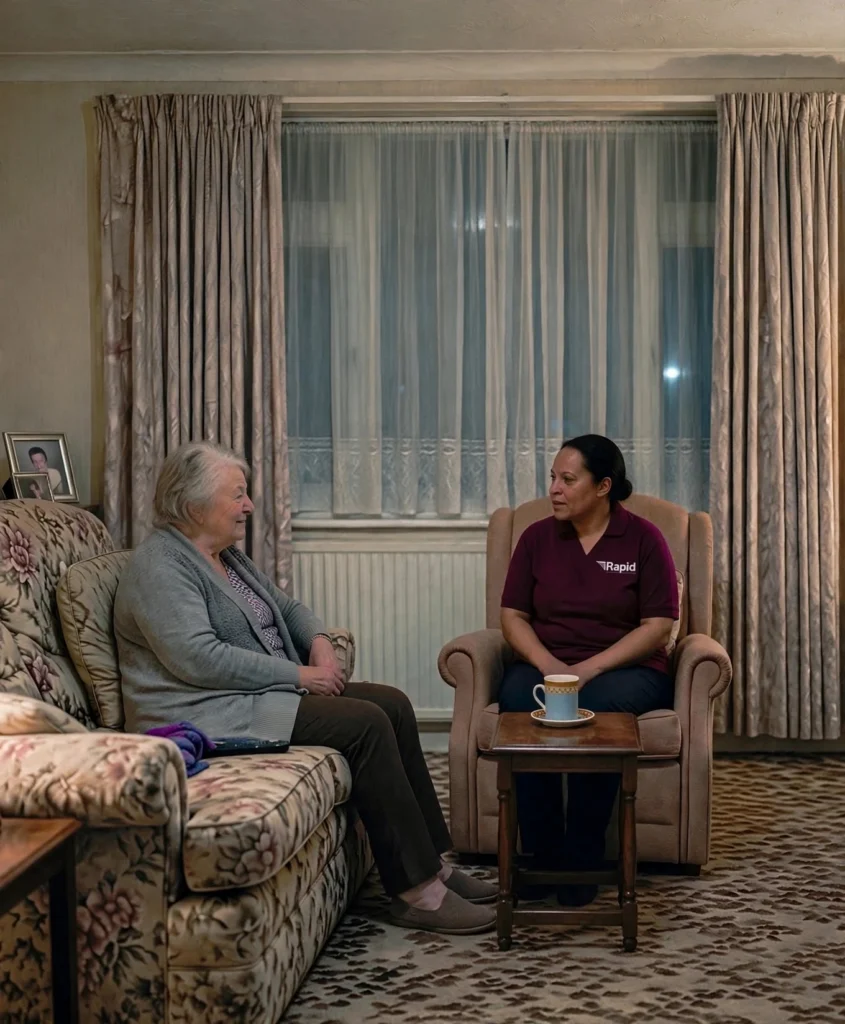
A carer moves into the home, has their own room and takes agreed daily breaks. They become part of the household rhythm: cooking, prompting medication, supporting personal care, keeping the house running and providing company. Pets stay. Neighbours stay. The garden stays.
24-hour and waking night care
Where needs are higher, we cover the clock with a rota of carers, including waking nights. This is common after a hospital discharge, in advanced dementia, or where two carers are needed for safe transfers.
A typical week
For live-in care, a typical week is really a typical day repeated with variation: the carer supports the morning routine, prepares meals, manages medication, keeps the home running and provides company, with an agreed daily break built into the schedule and cover arranged for that break and for the carer’s own days off; you are never simply left without support because a rota needs balancing. For rotating 24-hour teams, the pattern is a small number of carers working shifts, handing over to each other with written notes so nothing is lost between them.
How we train for this
Live-in and 24-hour carers are trained the same as every other role (Care Certificate, moving and handling, medication) plus specifically in sustaining a working relationship over long periods in someone’s home, which is a different skill from a 30-minute visit. Waking night staff are trained in the same way as day staff, not treated as a lesser or informal role.
What it tends to cost compared with a care home
Live-in care is charged as a package, not per visit, and for one person it often compares well with the cost of a good residential care home, sometimes more, sometimes less, depending on needs. For couples wanting to stay together, it is frequently the more affordable option, since a care home charges for two placements. We set out real costs at assessment rather than a generic comparison.
Who this is for
People who would otherwise be moving into residential care, couples who want to stay together, and families managing a rapid change in need.
What is included
- Full-time live-in carer with agreed breaks and respite cover
- Rotating 24-hour teams for higher-dependency needs
- Waking night and sleeping night options
- Two-carer (double-up) visits where assessed as necessary
- Continuity of the same small team wherever possible
- Emergency and short-notice packages considered
Talk it through first
A free home assessment with no obligation. We will tell you what we would recommend and what it would cost.
Common questions
Live-in & 24-hour care: what people ask
Is live-in care cheaper than a care home?
Often, especially for couples, but it depends on the level of need. See paying for care for funding routes and ask us for a real comparison at assessment rather than trusting a generic rule of thumb.
Where does the live-in carer sleep, and what breaks do they get?
In their own room in the home, with agreed daily breaks and cover arranged for days off: this is planned into the package from the start, not worked around afterwards.
Can we start with live-in care and move to a rotating team later?
Yes. Needs change, and the model can change with them: the point of the assessment and ongoing review is to keep matching the package to what is actually needed.
What is the difference between waking nights and sleeping nights?
A sleeping-night carer sleeps in the home and is available if needed; a waking-night carer stays awake and on duty throughout, for repositioning, continence support or medication at set times. Which one is right depends on the level of overnight need.
Often arranged alongside
Personal care
Discreet, dignified help with washing, dressing, continence and medication, delivered the way you would do it yourself.
Visiting care at home
Scheduled visits from thirty minutes upwards: practical help, companionship and a reliable pair of eyes on how someone is doing.
Night & overnight care
Waking nights and sleeping nights, so that nobody in the house is lying awake listening out.