
Dementia care
Why home often works better
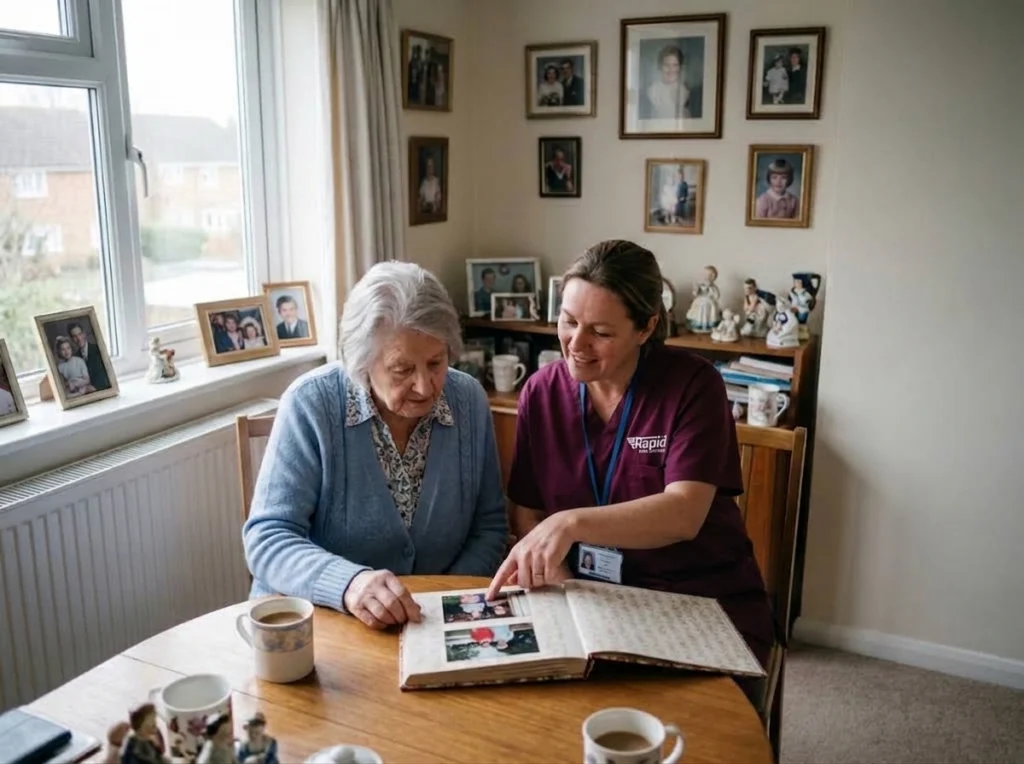
Familiar surroundings carry memory that a new building cannot. Someone who is lost in a care home corridor may be entirely capable of finding their own kitchen. We work with that, rather than against it.
How we train for it
Carers supporting people with dementia are trained in communication, de-escalation and recognising distress that is being expressed as behaviour. We plan for the difficult parts (sundowning, refusal of personal care, repetition) rather than reacting to them.
A typical week
There is no single pattern, because dementia care is one of the areas where the same diagnosis can mean very different levels of support. Early on, a package might be a daily visit to prompt medication and provide company and a safety check. Later, it is often multiple visits a day covering personal care, meals and orientation support, sometimes moving to live-in or 24-hour care as the risk of unsupervised time at home grows. We review the plan as things change rather than waiting for a crisis to force the conversation.
When this might not be the right fit
Home care depends on a home environment that can be made reasonably safe, and on risks (wandering, leaving the gas on, falls) that can be managed with the level of supervision a care plan provides. If risk grows beyond what visiting or even live-in care can safely cover, we will say so honestly rather than stretch a package past what is safe, and we can help you think through what a move to a specialist dementia care setting would involve.
Who this is for
People living with Alzheimer’s disease, vascular dementia and other forms of cognitive decline, at any stage.
What is included
- The smallest possible team of consistent carers
- Routines and prompts that support orientation
- Life-story work so carers know who they are supporting
- Support with eating, drinking and medication adherence
- Managing distress, agitation and sundowning calmly
- Practical guidance and respite for family carers
Talk it through first
A free home assessment with no obligation. We will tell you what we would recommend and what it would cost.
Common questions
Dementia care: what people ask
My relative refuses help: does that mean home care will not work?
Not necessarily. This is common and it is rarely about the care itself: it is about privacy and losing independence. Involving them in decisions (which tasks, when visits happen, meeting the carer beforehand) usually helps more than insisting. We would rather start with less help than needed and build trust than push too hard too soon.
Can carers manage medication for someone with dementia?
Yes, prompting, assisting with or administering medication is part of standard training, and for dementia specifically we plan around the routines and prompts that help someone accept it, not just the mechanics of giving it.
How is dementia care funded?
The same routes as any other homecare: self-funded, council-funded, direct payments, or occasionally NHS Continuing Healthcare where needs are primarily health-related. See paying for care for how each works.
What happens as needs increase?
We review with you rather than waiting for you to ask. A typical progression is from a daily visit to multiple visits, then to live-in or 24-hour care; we will tell you honestly when we think that point is approaching rather than let a package quietly become unsafe.
Often arranged alongside
Personal care
Discreet, dignified help with washing, dressing, continence and medication, delivered the way you would do it yourself.
Visiting care at home
Scheduled visits from thirty minutes upwards: practical help, companionship and a reliable pair of eyes on how someone is doing.
Live-in & 24-hour care
A carer living in the home, or a rotating team providing round-the-clock cover: a genuine alternative to a care home.